|
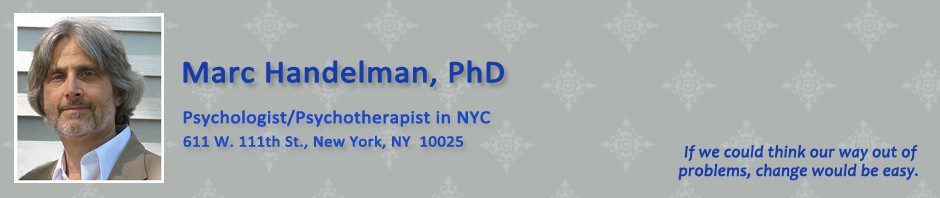
Marc Handelman, Ph.D. Clinical Psychologist |
|
|
611 W. 111th St. New York, NY 10025
Contact Information Phone: 212-678-1568 |
|
|
“.....If we
could think our way out of problems, change would be
easy.”
Welcome I am a licensed psychologist practicing in New York City. My office is located on the Upper West Side of Manhattan, near Columbia University. I work with adults from college age and up who want help addressing problems ranging from depression, anxiety, and relationship issues to addiction, co-dependency, and the effects of early trauma. I believe therapy should provide a sense of comfort and support as the starting point for addressing emotional problems. I have more than 30 years' experience as a psychotherapist, and have been affiliated with The Hazelden Foundation for the past 17 years. Effective therapy is more than just an intellectual exchange. Although expressing your thoughts is important, it is essential that the process develops into something deeper. Significant change takes place on an emotional level and involves reworking the way we feel. If we could think our way out of problems, change would be easy. Feelings aren’t always rational or subject to logic. A good fit with your therapist or counselor is essential in order to address difficult emotional issues. A sense of comfort and support are the starting points in the development of a safe and collaborative relationship, which is crucial for promoting growth and change. Therapy can fail when there is not a good fit.
My work is
insight-oriented with an
experiential and interpersonal focus. I am generally non-directive
although I
believe suggestions are occasionally helpful. While I have been
influenced by
humanistic, psychodynamic, interpersonal, existential, and experiential
approaches to psychotherapy, I have developed my own way of
understanding and
helping people. I generally don’t think of
people in
diagnostic terms and I believe that doing so can get in the way of
genuine understanding. People develop approaches to their lives
that are
more or less useful -- what is important is finding a way of being in
the world
that works for you. I’m interested in my patients finding a personally
meaningful way of understanding and approaching life. I believe
the
development of emotional insight is important, and I believe that being
clear,
direct, and open are positive goals. I am more interested in
helping
people see clearly than I am in optimism or pessimism. I believe
spiritual
issues can play a part in emotional healing and I am comfortable
working in a
12 Step framework. My style is non-judgmental and
empathic, and
my work involves an interactive process directed toward ending
self-criticism,
creating satisfying social relationships, and resolving conflict.
Suffering and
self-defeating patterns can be connected to despair, alienation,
depression,
anxiety, dependency, early trauma, and a multitude of addictive
behaviors --
all of which can be examined and addressed. An individual with a
traumatic
history may find that current events trigger emotional states
associated with
past traumas, and may need help integrating those painful events into
their
current life. Although addressing the
immediate and painful
issues that often bring people to therapy is critical, I also believe
that deep
and lasting change and health stem from self understanding and
self
acceptance. Specific goals formulated when starting therapy may
change
along the way as new possibilities are discovered. While
resolving deeper
issues may take some time, I also believe if a person does not
experience some
benefit from therapy early on, it may make sense to stop or to search
for
another therapist. Psychotherapy need not be a life style.
Therapy is
finished when you have a handle on primary problems and when it is no
longer
worth your time and money.
A productive therapeutic environment needs to be a safe place to explore issues that may be painful. It must provide an opportunity to express your full range of emotions, thoughts, memories, and fears. It should also lead to an experience of increased hope. In this kind of setting, one can generate new perspectives and creative approaches to life. The process can be difficult but it is not always a somber pursuit. It can also incorporate playfulness and humor. Trust, respect, compassion, and empathy are things you feel – they are not things you are “convinced” of – and this may take time to develop. Trust is not based on words alone; it is something you experience as you and your therapist get to know each other. Your therapist’s attitude is critical and can lead to your feeling accepted and understood, or rejected and judged, regardless of the specifics being addressed. Frequently, the things we find hardest to accept in ourselves are the things that cause us the most pain and suffering. Self-acceptance is a prerequisite of fundamental change, and it is easier to accept yourself in an accepting environment. When a positive alliance has developed, patients use the therapeutic relationship to transform and rework significant emotional experiences and family issues. Therapy then becomes a place to learn how to identify and change an approach to life which led to conflict and suffering. It is important that you learn to make choices and listen to your own inner voice. While some direction, advice, and counseling may be helpful at times, there will also be times when the best thing your therapist can do is stay out of the way and listen. Learning to trust your own experience is crucial. Feeling pressured to be something or do something or say something will frequently interfere with self-acceptance. Because the therapist’s input is important, it is critical that he be sufficiently aware of his own defenses and biases that they don’t interfere with a clear understanding of the person he is helping. Your therapist must be careful not to respond based on his own conflicts or issues. A failure of self awareness on the part of the therapist can lead him to be overly involved, or overly detached. He must be compassionate without being enmeshed or entangled. He must be objective without being disconnected. He needs clear boundaries to allow his patients to clarify their own boundaries. Clarity is not only important for you, it is important for your therapist. These points are essential in maintaining a safe environment and an ethical stance.
If you have insurance psychotherapy is often covered although policies differ from plan to plan. I may be flexible with my fee depending on a number of factors. Click HERE for more details. I am aware of the difficulties dealing with insurers and I will provide all reasonable assistance to help you receive benefits. I am working for you, not the insurance companies.
I am a licensed psychologist and have been in private practice since I received my Ph.D. in 1980. I am also a supervising psychologist at The Hazelden Foundation, which is a 12 Step-oriented treatment center for addictions and mental health issues. Click HERE to see my professional history. |
|
|
Marc Handelman, Ph.D. 611
W. 111th St., New York, NY 10025 Nearby Zips: 10019, 10023, 10024,
10025, 10027
Tel. 212-678-1568 Email: drhandelman@gmail.com |
|
| Click for a map:
611 W 111th St, New York, NY, 10025
Some helpful internet search terms: Therapists NYC, Psychologists NYC, Counselors NYC, Therapy NYC, Find psychotherapists in Manhattan. Addictions, 12 Step programs, ACOA,
Treatment for early truama, Alanon, CODA. © 2010 Marc Handelman |
|